
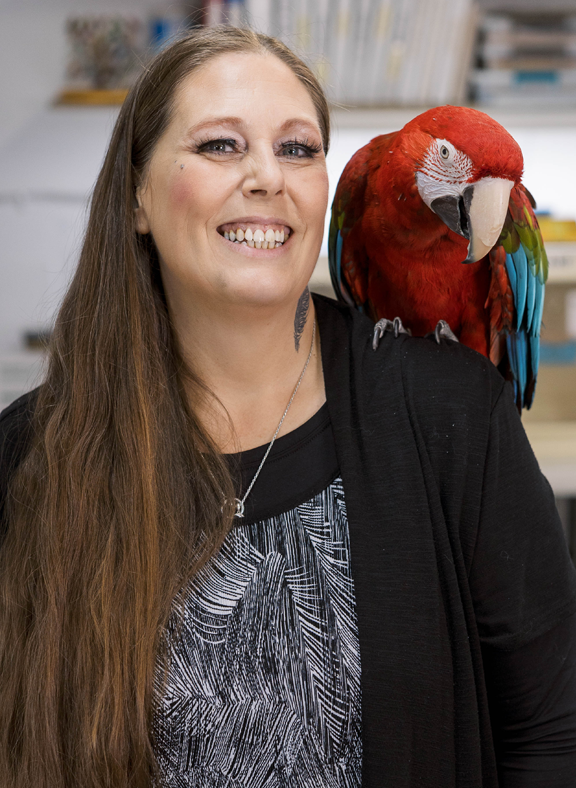
ANGELA VANHOY
Director of Rehabilitation
Angela “Angie” Vanhoy serves as Director of Rehabilitation at Carolina Waterfowl Rescue, overseeing the medical care and rehabilitation of CWR’s diverse population of injured, ill, orphaned, and displaced animals.
Angie joined CWR in September 2020 while searching for a more meaningful career path. Although she had previously worked in animal healthcare, her professional life had taken her in several different directions. Coming to CWR reconnected her with the work she found most fulfilling: caring for animals that needed someone to advocate for them.
Her career at CWR began as a Front Desk Administrator. Over the years, she also served as Volunteer Coordinator, Outreach Director, and Hospital Administrator before ultimately becoming Director of Rehabilitation.
Today, Angie leads a rehabilitation program responsible for animals representing an extraordinary variety of species and medical needs.
Her work encompasses virtually every stage of patient care. Angie assists with examinations and safe restraint, monitors vital signs, calculates and administers medications, vaccines, fluid therapy, and tube feedings, collects and evaluates laboratory samples and results, operates diagnostic imaging equipment, and reviews radiographs.
She prepares patients for surgery, assists during procedures, monitors anesthesia, supports post-operative recovery, performs wound care and debridement according to treatment plans, and provides emergency first aid under veterinary direction. She also maintains patient records, treatment plans, medication and controlled-substance documentation, and daily patient-location inventories.
As Director of Rehabilitation, however, Angie's responsibilities extend well beyond individual patient care.
She supervises and coordinates rehabilitation staff, interns, and volunteers; manages scheduling and clinical workflows; trains team members; oversees supplies and medical equipment; supports administrative, technology, bookkeeping, and reporting functions; and helps ensure the rehabilitation program complies with applicable licensing, reporting, safety, and documentation requirements.
She also continues to participate directly in rescue work, including transporting animals, responding to hotline inquiries, assisting with fundraising and communications, and helping recover escaped parrots.
One of Angie's proudest accomplishments has been helping expand CWR's medical and diagnostic capabilities. She helped implement resources including radiology, in-house blood testing, and fecal testing, giving CWR's rehabilitation and veterinary teams faster access to information about a patient's condition.
For Angie, these aren't simply technological improvements. Faster diagnostic information can help the team make more informed treatment decisions, adjust medications when necessary, respond more quickly to changes in a patient's condition, and ultimately provide a higher standard of care.
That focus on observation and problem-solving is central to the way Angie approaches animal rehabilitation.
Animals cannot explain where they hurt or describe how they feel. Angie believes rehabilitators must learn to slow down, observe carefully, recognize subtle behavioral and physical changes, and use those clues to understand what an animal may be experiencing. She finds the process of piecing those clues together and determining how to help one of the most rewarding parts of her work.
Angie's clinical foundation began decades before CWR.
After high school, she enlisted in the United States Navy and served as a hospital corpsman. Following her military service, she trained and worked as a veterinary technician, developing practical experience in animal handling and restraint, patient observation, vital-sign monitoring, medication administration, specimen collection, recordkeeping, sanitation, and assisting veterinary professionals with examinations and treatments.
She later served as a correctional officer with the North Carolina Department of Correction and worked in manufacturing before joining CWR in 2020.
Angie continues to build upon her professional training. In 2026, she became a Certified Aviculturist Level II through the American Federation of Aviculture and completed management certification through IAP Career College as well as controlled-substance training. She is also pursuing certification as an Avian Trainer through the International Avian Trainers Certification Board and plans to continue her education as animal-care practices and technology evolve.
Her experience with animals reaches even further back.
As a child, Angie participated in Mecklenburg County 4-H, earning ribbons for raising rabbits and chickens and demonstrating her knowledge of equine care. As a teenager and young adult, she worked on horse farms training and exercising horses. She later competed in hunter/jumper and Western pleasure disciplines and continues to enjoy recreational trail riding.
Today, Angie has experience with a wide variety of animals, including parrots and other birds, snakes, turtles, horses, donkeys, chickens, geese, and swans.
But parrots occupy a particularly special place in her life.
Angie serves as Executive Director of Free Spirit Parrot Sanctuary and has developed an extraordinary ability to work with parrots that need patience and consistency to rebuild their trust in people. Family members and Renaissance festival patrons have affectionately nicknamed her the “Parrot Whisperer” and the “Quaker Queen.”
That connection has occasionally proved useful in unexpected circumstances. Angie has assisted in recovering escaped parrots, including birds perched high in trees that chose to come down shortly after she approached.
She is fascinated by parrots' intelligence, individuality, and ability to form complex relationships, and she devotes considerable time outside CWR to educating others about responsible parrot ownership. At Renaissance festivals along the East Coast, Angie appears as a pirate captain accompanied by some of her birds while teaching the public about parrot husbandry, nutrition, enrichment, health, and the significant lifelong commitment these intelligent animals require.
She has also created Cooking with Companions, an educational cooking channel focused on proper parrot nutrition.
Angie's own animal family could nearly qualify as a small sanctuary itself. Her home includes numerous parrots representing species ranging from Quakers and conures to African greys, Amazons, cockatoos, Eclectus parrots, and several species and hybrids of macaws.
And the birds are only the beginning.
Her family also includes ducks, geese, European starlings, a turkey, five dogs, an axolotl, two tortoises, and an Arabian horse named Pride. Caring for such a diverse group requires considerable time and dedication, but Angie wouldn't have it any other way.
When she isn't caring for animals, Angie enjoys painting and experimenting with new artistic techniques. Her artwork was once exhibited in a gallery, although her increasingly busy life eventually left less time to pursue it professionally.
She is also an enthusiastic science-fiction and fantasy reader with a particular love for The Hobbit and The Lord of the Rings, enjoys puzzles—preferably with birds on them—and continues to travel to Renaissance festivals along the East Coast.
There is still one animal adventure Angie hopes to undertake.
One of her long-term goals is to travel to the Peruvian Amazon and intern with The Macaw Society, participating in field conservation work supporting wild macaw populations. The demanding experience would combine many of the things that have shaped her life: animals, observation, problem-solving, science, and conservation.
For Angie, the motivation behind all of these pursuits is ultimately the same one that brought her to CWR.
Animals cannot ask for help in words.
Whether the patient is a tiny bird requiring intensive supportive care, a critically injured waterfowl patient, a frightened parrot learning to trust people again, or an animal whose condition presents a difficult medical puzzle, Angie believes people have a responsibility to pay attention, understand what the animal is telling them, and advocate for the care it needs.
At CWR, she has found a career that allows her to do exactly that.