
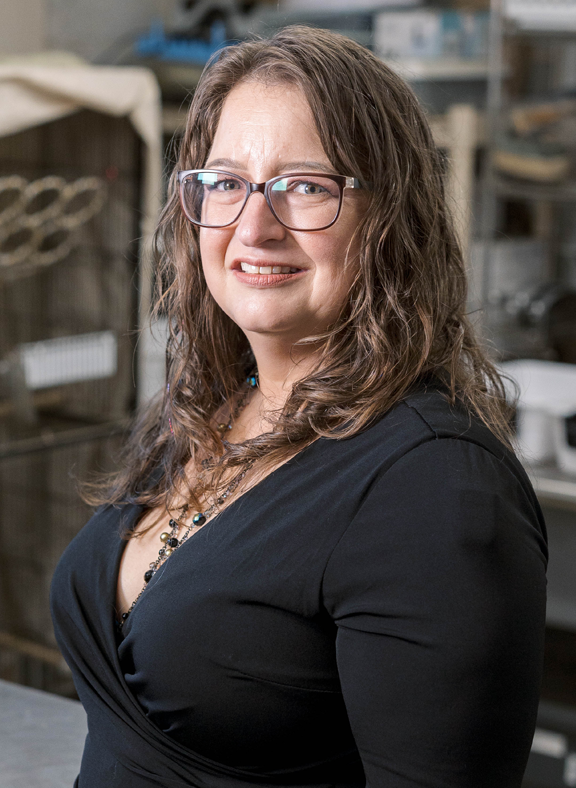
Stephanie M. Cawthorn, DVM
Staff Veterinarian
Dr. Stephanie Cawthorn has wanted to be a veterinarian for as long as she can remember. Animals, service, and an eagerness to keep learning have shaped both her professional career and her path to Carolina Waterfowl Rescue.
Stephanie first learned about CWR many years ago after her sister-in-law, who lived in the area, shared one of the rescue's posts. The idea of an organization devoted to ducks, geese, and other frequently overlooked animals immediately caught her attention.
There was just one problem: Stephanie lived approximately three hours away.
For several years, she followed CWR from a distance, wanting to become involved but unsure how she could realistically volunteer so far from the rescue. Eventually, she learned that CWR needed transporters in her area. She began helping capture animals and occasionally transporting them to the rescue.
That was the beginning.
As Stephanie met more CWR volunteers, her involvement continued to grow. When she later saw a request for someone to hold and stabilize animals for a day before they could continue their journey to the rescue, she volunteered. Eventually, she was able to spend several weeks working directly with CWR's rehabilitation team. From there, she began contributing her veterinary skills, and her role continued to expand.
Today, Dr. Cawthorn serves as CWR's Staff Veterinarian, overseeing medical care and working closely with the rehabilitation team on treatment and medication administration. Her work includes evaluating patients, guiding medical care, triaging and stabilizing animals, and performing surgeries across a remarkably diverse range of species.
Many of those procedures involve seriously injured waterfowl, including geese requiring wing amputations, but Stephanie's surgical patients can also include reptiles, snakes, and other animals that arrive at CWR needing specialized care.
One of the things she finds most rewarding about wildlife and exotic animal medicine is also one of its greatest challenges: there is always something new to learn.
Stephanie is particularly passionate about expanding her knowledge of medicine in species that are not as extensively studied as traditional companion animals. Rather than expecting that learning process ever to end, she embraces it. Observing animals closely—their behavior, body language, responses, and individual differences—is an important part of how she continues to grow as a veterinarian.
Stephanie earned her Bachelor of Science in Animal Science from North Carolina State University in 2006, graduating as valedictorian with a minor in nutrition. During college, she was heavily involved with the Animal Science Club for all four years, serving in numerous leadership roles including president, vice president, and parliamentarian.
Her undergraduate experience also included hands-on work with livestock. She showed goats and dairy cattle at the North Carolina State Fair and worked with dairy cattle, sheep, swine, and beef cattle through Club Day activities. She also served as a dairy cattle species chair and was a member of Alpha Zeta, an agricultural honors fraternity, for three years.
Stephanie continued at NC State, earning her Doctor of Veterinary Medicine in 2010.
Her veterinary education also took her far outside the traditional classroom and clinic. While in veterinary school, she spent six weeks in Navajo Nation doing mission work with Christian Veterinary Mission and spent a week in Gulfport, Mississippi, assisting with post-Hurricane Katrina recovery efforts.
One of her most unusual experiences came during veterinary school when she spent three weeks aboard a shrimp boat participating in sea turtle rescue work. The experience gave her hands-on opportunities to process rescued sea turtles, collect blood samples and data, perform tagging, and work with bycatch that included sharks and stingrays.
Stephanie has continued pursuing education relevant to wildlife medicine throughout her career. In 2023, she completed an eight-hour continuing education course through the Veterinary Information Network focused on wildlife rehabilitation and orthopedic procedures.
Professionally, Stephanie has been with Ambassador Animal Hospital since 2020, initially serving as an Associate Veterinarian before becoming Chief of Staff Veterinarian in 2022. She has been a member of both the American Veterinary Medical Association and North Carolina Veterinary Medical Association for approximately 16 years.
Community service, animal rescue, and volunteer work have been part of Stephanie's life since high school, and animals are just as central to her personal life as they are to her professional one.
She has kept poultry—including chickens, ducks, geese, turkeys, and pigeons—since 2019 and has spent her life around horses, dogs, cats, fish, reptiles, and other small animals.
Several members of her current animal family have CWR connections.
Cricket is a young house chicken who, as Stephanie puts it, probably should never have hatched. Squirrel, whose history is largely unknown, came from CWR and now lives alongside Cricket. Cupid is a Muscovy drake who was found shortly after hatching on a freezing winter day and required weeks of critical care before becoming stable. Louie is a male pigeon adopted from CWR.
And those are only a few. Stephanie has also adopted numerous chickens, ducks, snakes, geckos, and other animals through CWR over the years.
While she is reluctant to choose favorites, poultry—and geese in particular—rank very high on her list.
Stephanie believes geese are widely misunderstood. They are highly social animals with their own forms of communication, relationships, and behavioral cues. Once people take the time to understand their language, she believes they begin to see an entirely different animal.
That curiosity extends to every species she encounters. Stephanie enjoys simply observing animals and learning to understand their body language and behavior, and she plans to remain a student of animals throughout her life.
When she isn't practicing veterinary medicine or working with CWR, much of Stephanie's time still revolves around animals. She cares for her poultry, dogs, cats, fish, geckos, snakes, and other reptiles, enjoys horseback riding, and values time with family and friends and involvement with her church.
At CWR, the same curiosity that led Stephanie toward veterinary medicine as a child continues to drive her today.
Every unusual patient, unfamiliar species, complicated injury, and difficult case presents another opportunity to learn—and another opportunity to use that knowledge to give an animal a chance it might not otherwise have had.
For Stephanie, there will always be something new to learn.
And that's one of the reasons she continues to love the work.