
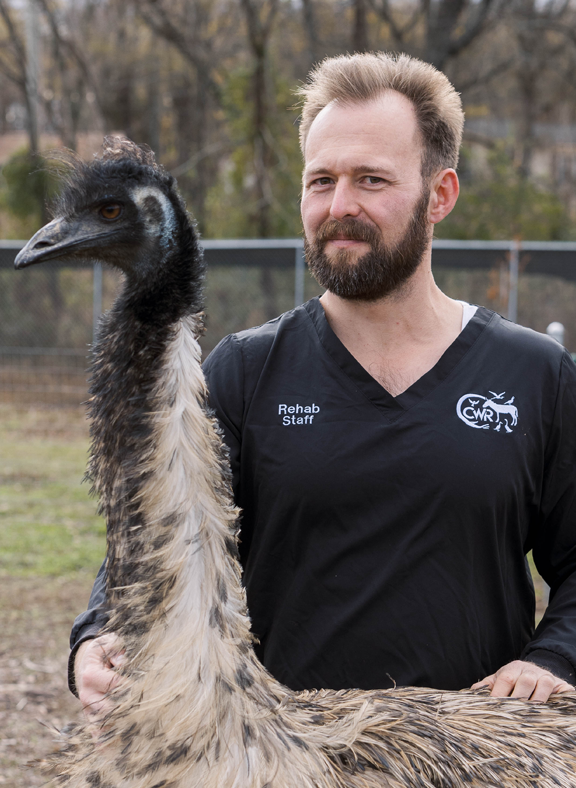
Stephen Platte
Rehab Technician
Stephen Platte's history with Carolina Waterfowl Rescue began long before he became an employee. After college, while looking for an opportunity to volunteer with wildlife, he discovered CWR and was drawn to an organization that seemed different from the other opportunities available to him.
He would ultimately spend approximately 10 years volunteering on CWR's animal care shifts before joining the staff. During his six years as an employee, Stephen also spent three years as a Shift Leader before moving into his current rehabilitation role.
That long history has given Stephen the opportunity to experience CWR from multiple perspectives—from routine animal care and facility operations to leadership, training, and hands-on medical rehabilitation.
Today, Stephen performs daily treatments for CWR's patients, helps develop treatment plans for newly admitted animals, and works to maintain the rehabilitation facility to exacting standards of cleanliness and organization. He also helps train interns and new staff members, sharing the knowledge he has developed through years of practical experience so they can get the most from their time at CWR.
Stephen works with the wide variety of animals that arrive at the rescue but has particular experience with parrots and larger patients.
His knowledge of parrots extends well beyond his work at CWR. Stephen has also worked for Companion Parrots Re-homed, a parrot rescue and adoption organization, for at least a decade. Combined with caring for parrots of his own, this has given him years of practical experience understanding the specialized husbandry, behavior, nutritional needs, and individual personalities of companion parrots.
Although parrots are not among CWR's most frequent admissions, Stephen's extensive background with them becomes particularly valuable when one does arrive. He works with CWR's rehabilitation team to ensure these birds receive appropriate housing, nutrition, handling, and species-specific care during their time at the rescue.
Larger birds present a different challenge. Domestic geese and similar patients may be powerful, frightened, and understandably unaware that the humans attempting to examine them are trying to help. Safely restraining these animals requires patience, confidence, and an understanding of how to balance the needs of the medical team with the safety and stress level of the patient.
Stephen holds a Bachelor of Science in Ecology and Evolution from the University of North Carolina Asheville. He has also volunteered in rehabilitation with the Carolina Raptor Center and has spent much of his life seeking opportunities to learn about wildlife and the natural world. In the future, he would like to continue developing his professional skills by working toward wildlife rehabilitation licensure and training related to venomous reptiles.
His interest in animals began as far back as he can remember. Stephen always imagined that animals would eventually become part of his career, and his academic interests naturally gravitated toward ecology, evolution, wildlife, and the outdoors.
During school, he was an avid backpacker and birder. Some of his outdoor adventures involved searching the Blue Ridge Mountains for salamanders—an activity that combined his interest in wildlife with the opportunity to observe animals in their natural environments.
After college, Stephen began looking for volunteer opportunities and found Carolina Waterfowl Rescue. What started as volunteering eventually developed into a long-term commitment and, ultimately, a career in animal rehabilitation.
One aspect of CWR's mission that remains particularly meaningful to Stephen is the organization's willingness to help animals that can easily be overlooked.
CWR cares for an unusual combination of wild and domestic birds and other animals, including species that may have relatively few options when they need assistance. Stephen particularly appreciates CWR's dedicated songbird program, which provides specialized care for both adult and baby songbirds during the demanding spring and summer seasons.
He also values the network of people behind that work—from CWR's staff and volunteers to the individuals and organizations that collaborate with the rescue.
Among the many animals Stephen has encountered, chickens remain some of his favorites. He appreciates their curiosity, energy, and individual personalities and jokes that the roosters often seem to possess Napoleon complexes.
Emus are another favorite. Despite their intimidating size and reputation, Stephen sees them somewhat differently: intensely curious animals that aren't necessarily aggressive—they simply don't have much appreciation for the concept of personal space.
Stephen's connection with birds continues at home, where he has two parrots: a male Eclectus and a Goffin's cockatoo. He also shares his home with a mixed-breed dog.
Outside of work, Stephen remains interested in the outdoors, although he has less time for backpacking than he once did. He enjoys learning about martial arts and calisthenics and reading about medieval history and philosophy. Fantasy is another favorite, particularly The Witcher series and The Lord of the Rings.
After so many years at CWR, what keeps Stephen passionate about the work can be summed up simply: the successes.
Every patient that recovers, every difficult case that turns a corner, and every animal that gets another chance provides another reminder of why the work matters.
For someone who began as a volunteer looking for an unusual way to work with wildlife, those successes have turned Carolina Waterfowl Rescue into much more than a volunteer opportunity. They have become the foundation of a career—and a life—devoted to understanding, caring for, and advocating for animals.