
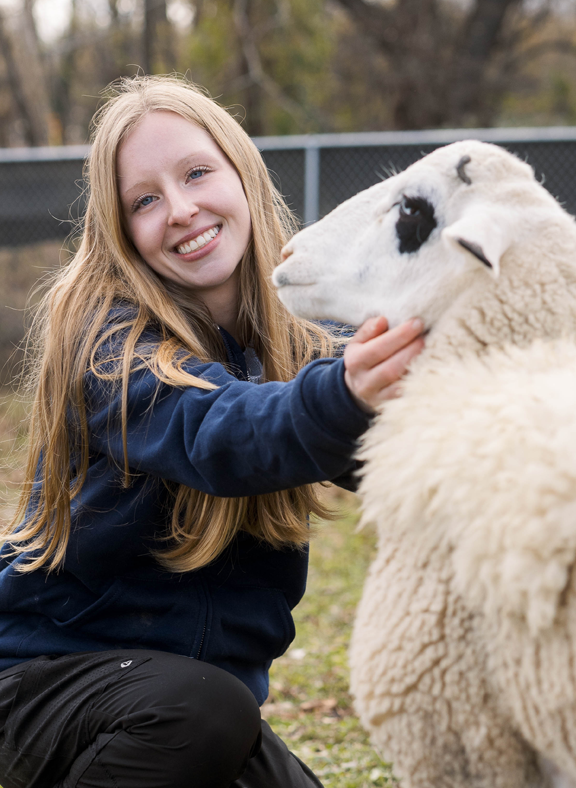
Taylor Casteen
Weekend Assistant Rehab Manager
Taylor Casteen serves as Weekend Assistant Rehab Manager at Carolina Waterfowl Rescue, where Taylor helps oversee the medical care and rehabilitation of injured and ill wildlife while training staff and interns in the skills needed to provide that care.
Taylor's path to CWR began shortly after graduating from the University of North Carolina at Pembroke in 2024 with a Bachelor of Science and a concentration in Zoology. A lifelong love of animals had made a career involving wildlife a natural goal, but finding an opportunity to gain hands-on experience after graduation proved challenging. When Taylor discovered an opening for a rehabilitation internship at CWR, it seemed like the opportunity to finally put that education and passion into practice.
Taylor joined CWR as a Rehabilitation Intern in March 2025. During the internship, Taylor learned the fundamentals of hands-on wildlife rehabilitation, including administering medications, preparing appropriate food and water for different patients, maintaining patient enclosures, assisting with wound care, providing fluid therapy and tube feedings, and performing radiographs.
By the conclusion of the internship in August 2025, Taylor had earned a permanent position on CWR's rehabilitation staff. Just over a year later, in September 2026, Taylor advanced to Weekend Assistant Rehab Manager.
Today, Taylor helps oversee CWR's rehabilitation operations on weekends and provides care for waterfowl, reptiles, and other animals requiring medical attention. Responsibilities include assessing patient needs, developing and adjusting treatment plans, administering medications, determining when supportive care such as tube feeding or fluid therapy is necessary, performing wound care, and monitoring patients throughout rehabilitation.
Taylor is also trained in CWR's protocols for controlled substances and euthanasia and is responsible for the proper management and documentation of controlled medications while working in a supervisory capacity.
The rehabilitation department cares not only for newly admitted wildlife but also for animals elsewhere on CWR's property who begin showing signs that something is wrong. When staff or volunteers notice that a resident or rehabilitation patient appears sick, injured, or simply “not themselves,” the animal can be brought to the rehabilitation team for evaluation and treatment.
An increasingly important part of Taylor's position is teaching others. Taylor trains rehabilitation interns and staff, answers questions about patient treatment, and helps team members develop the practical skills and confidence required to work with injured wildlife.
That process is particularly rewarding. Taylor remembers what it feels like to be a nervous new intern learning unfamiliar medical procedures and enjoys watching that uncertainty gradually disappear as new rehabilitators become comfortable and confident in their abilities.
Taylor also assists with adoptions when animals with previous medical conditions are placed into homes, helping adopters understand the animal's history and any relevant information about injuries or treatment. After-hours animal care is another part of the job, sometimes requiring Taylor to provide overnight supportive care until a patient can be brought to CWR the following day.
Of all the stages of rehabilitation, release remains the most meaningful.
For Taylor, there is something extraordinary about seeing an animal arrive sick or injured, providing the care necessary to help that animal recover, and ultimately watching it return to the place—and sometimes the family—it came from. The opportunity to complete that entire journey from intake through recovery and release is one of the greatest rewards of the work.
Taylor's connection with animals began long before CWR. Growing up surrounded by animals and wildlife created an appreciation for creatures of every size. Today, Taylor's home reflects that lifelong commitment to animals and includes a number of rescued pets, including cockatiels and budgies adopted through CWR, as well as rescued rats, cats, a dog, and other animals.
One CWR patient had a particularly lasting impact. During Taylor's internship, a male Black Swedish duck named Snoopy arrived at the rescue. Snoopy had plenty of attitude—and that was exactly what Taylor loved about him. Caring for him created a strong bond, and his eventual passing was heartbreaking. The experience left Taylor with a particular affection for male ducks and an appreciation for their sweetness, individuality, and often larger-than-life personalities.
When not working at CWR, Taylor spends much of that time caring for animals at home and enjoys traveling to visit and spend time with family.
Taylor also plans to continue pursuing educational opportunities in wildlife rehabilitation and expanding the knowledge and skills needed to provide increasingly advanced care.
At the end of a busy day, Taylor knows there will always be another patient to admit, another enclosure to clean, another treatment to perform, and another animal that needs help. What makes the work worthwhile is knowing that the CWR team did everything possible that day to help as many animals as it could—and will return the next day ready to do it again.